Welcome to Proctosafe Clinic, where we combine centuries-old Ayurvedic wisdom with modern surgical precision to help you leave pilonidal discomfort behind—for good.
What is a Pilonidal Sinus?
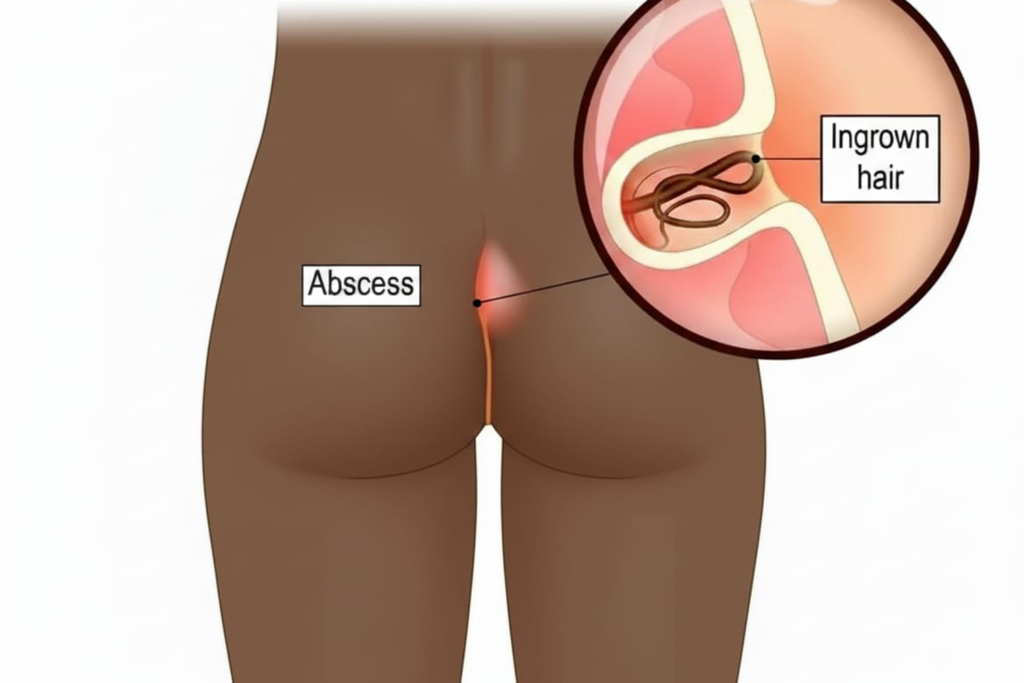
A Pilonidal Sinus (PNS) is a small tunnel or tract that develops under the skin at the top of the buttocks cleft (the sacrococcygeal area). Think of it as a stubborn, unwanted “pocket” that often becomes a hideout for hair, skin debris, and bacteria, leading to painful infections.
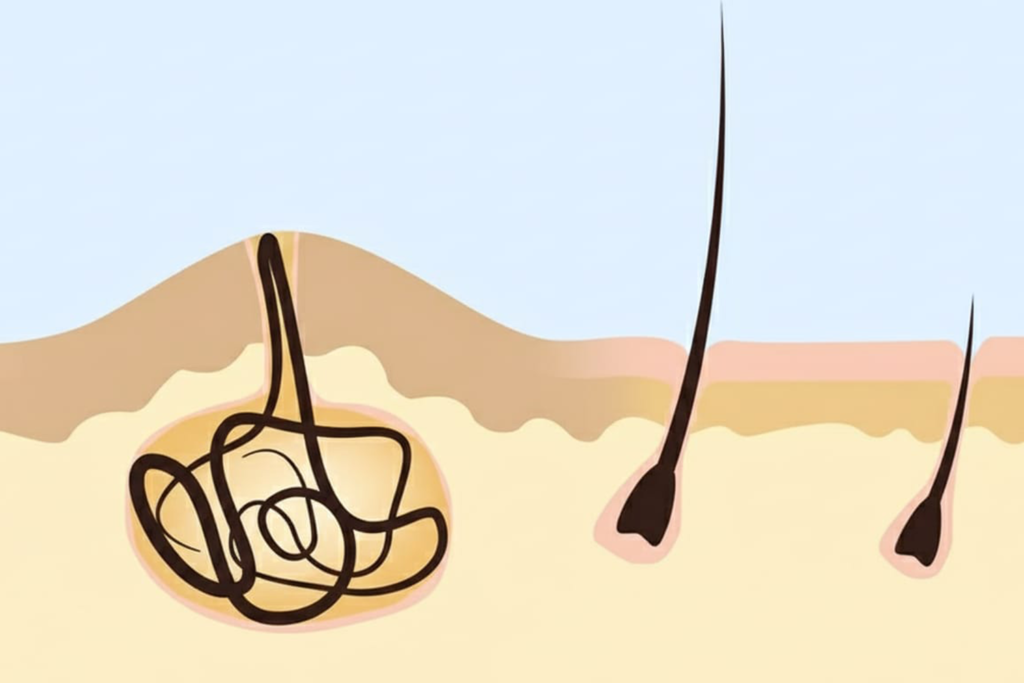
While the name sounds complex, it translates simply: Pilus (hair) and Nidus (nest). Essentially, it is a “nest of hair” that has lost its way.
The journey from healthy skin to a sinus tract usually follows a specific path:
Follicular Occlusion: A hair follicle in the midline of the buttock crease becomes blocked.
Infection: Friction and moisture cause the follicle to rupture into the deeper tissues, creating a small pit.
Foreign Body Reaction: Loose hairs are sucked into these pits by the “vacuum effect” created when you walk or sit. The body treats this hair as a foreign invader.
Abscess & Sinus Formation: Chronic inflammation leads to an abscess (pus collection), which eventually bursts or is drained, leaving behind a permanent tract—the sinus.
Common Causes & Risk Factors
Prolonged Sitting: Often called “Jeep Rider’s Disease.”
Coarse or Curly Hair: More likely to poke back into the skin.
Friction & Pressure: From tight clothing or cycling.
Obesity: Deeper skin folds trap more moisture and hair.
Clinical Features: Signs to Watch For
A pilonidal sinus can remain silent for a while, but once it flares up, it’s hard to ignore. Symptoms include:
The “Lump”: A painful swelling or mass near the tailbone.
Discharge: Pus, clear fluid, or blood leaking from a small opening.
Foul Odor: A common sign of an active infection.
Redness & Heat: The skin becomes tender and warm to the touch.
Systemic Signs: In severe cases, you may experience fever or malaise.
At Proctosafe Clinic, diagnosis is straightforward. Our experienced surgeons typically use:
Clinical Examination: A physical visual check is usually enough to confirm the presence of sinus pits.
Medical History: Discussing the frequency of flare-ups.
Probing (if needed): Using a fine, sterile probe to determine the depth and direction of the tract.
Imaging: In complex cases, an ultrasound or MRI might be used to map out multiple branches of the sinus. X-Ray of spine is often advised to rule out any disease of spine.
Pilonidal Sinus Treatment with Ksharasutra: A Speciality Ayurvedic Treatment at Proctosafe Clinic
If you’ve researched pilonidal surgery, you’ve likely heard of “wide excision”—a procedure that leaves a large wound and has a high chance of the sinus returning. We do things differently.
Our clinic specializes in Ksharasutra Therapy, a minimally invasive surgical procedure performed by expert Ayurvedic surgeons which offers highest success rate with minimal loss of tissue and working day.
Ksharasutra involves a medicated thread coated with organic herbs (like Snuhi latex, Apamarga, and Haridra). This thread is gently placed into the sinus tract. The medicine on the thread simultaneously cuts and heals the tract, chemically cauterizing the infected tissue and ensuring that no “hair nests” are left behind.